What is it?
Our data platform automatically checks observations for potential issues as they're submitted. When something looks off, the platform flags it so data collectors can review and correct it early, and dataset administrators get a clearer, more efficient way to review incoming data.
These checks are part of a broader quality assurance and quality control (QA/QC) process. QA/QC is how monitoring programs catch and correct errors so the data they collect can be trusted and used with confidence.
The process works in two steps:
- automated checks flag potential issues at submission,
- dataset administrators review flagged observations to correct them or make sure real results aren't mistakenly treated as errors.
Here’s what to expect:
- Observations that may need review are clearly flagged in the platform.
- A note is added to any flagged observation explaining why it was flagged.
- Dataset administrators have final review and approval of all observations.
- When a dataset administrator leaves a note on an observation, the data collector gets an email notification.
A note on QA flags
Our automated checks are designed to catch common issues, but they aren't perfect. A flag doesn't mean the data is wrong. It means the observation is worth a second look. Some true and important results will be flagged, especially if they fall outside typical site conditions. And not every potential issue can be automatically caught. We'll keep refining the rules based on community feedback.
What do the QA status labels mean?
The platform assigns each observation a QA status to communicate whether any action is needed.
| QA status | Explanation | Status assigned by |
| Reviewed: quality check complete | Automated QA checks found no issues with this observation (note issues may still be present). | Water Rangers QA, dataset administrators |
| Needs review | One or more readings in the observation are unusual for the parameter or unlikely based on past observations at the site and need review. | Water Rangers QA, dataset administrators |
| Issue detected | One or more readings in the observation exceed plausible limits (i.e pH values below 2). | Water Rangers QA, dataset administrators |
| Follow-up needed | Investigation is ongoing. One or more issues need to be confirmed and/or corrected with the data collector. | Dataset administrators |
| Approved by dataset admin | The dataset admin completed a secondary review of the flagged observation and has confirmed it is correct. | Dataset administrators |
Why is it important?
High-quality data is what makes community water monitoring meaningful. Small mistakes like a typo or a unit mix-up can reduce confidence in results or limit how the data gets used.
Previously, Water Rangers staff manually reviewed new data each week. That process was slow and still left room for things slipping through. Automated checks add an earlier, more consistent layer of review so data collectors and administrators spend less time hunting for errors and more time using the data.
Water Rangers is part of the Catchment Systems Thinking Cooperative (CaSTCo) partnership in the UK, a collective working to develop tools and best practices for community scientists collecting and sharing their data. Read more here.
With automated QA, Water Rangers takes a big step toward more reliable data, smoother workflows, and better support for everyone contributing to freshwater monitoring.
Common issues the checks catch
- Results recorded in the wrong units (°F instead of °C, for example)
- Zeros used as placeholders when a measurement wasn't taken
- Typos and decimal errors (recording 5.82 instead of 582 for conductivity)
- Readings that differ significantly from typical measurements at that site
Who is responsible in your organization?
The automated checks run quietly in the background the moment an observation is submitted. No action needed from you for that part.
Click here to see the rules and equipment limits used to flag results for review.
Data collectors are responsible for reviewing any flags on their observations and correcting accidental errors. Dataset administrators are responsible for regularly reviewing flagged data, approving accurate observations, and following up with collectors where needed.
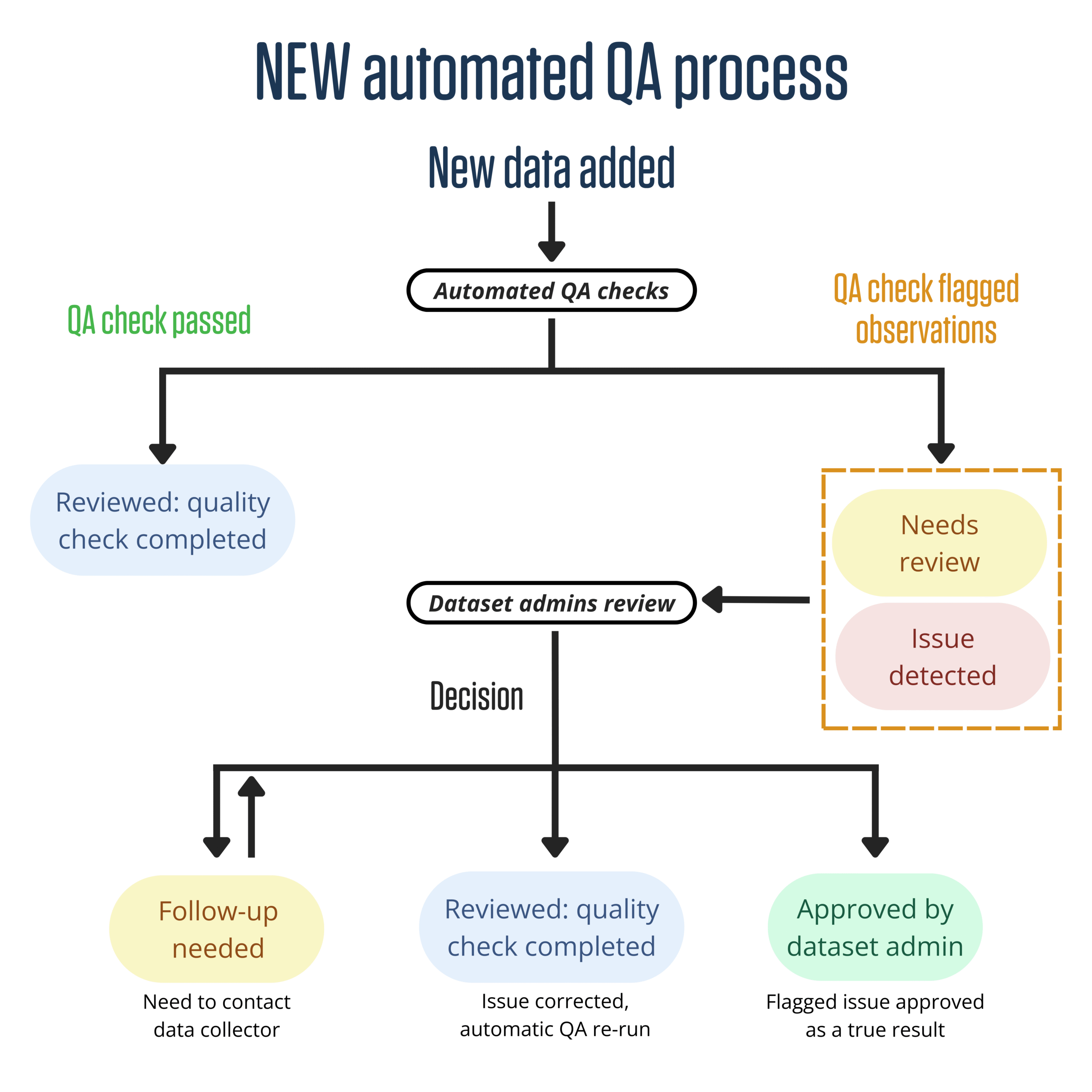
The flow diagram below shows how the process works for every new observation. Dataset administrators can also use QA statuses to manually flag observations that the automated system didn't catch.
How do you do it?
If you’re a data collector
Automated checks make it easier to catch and fix accidental typos or data entry errors before they become a problem.
- Review any quality flags that appear on your observations.
- If you made an error, edit the observation to correct it.
- If the result is correct, add a note on the observation explaining the context.
- You'll get an email notification when a dataset administrator leaves a note on one of your observations.
Watch this video demonstrating the process in action
If you’re a dataset administrator
Automated QA gives you a structured, efficient way to review data without checking every observation manually.
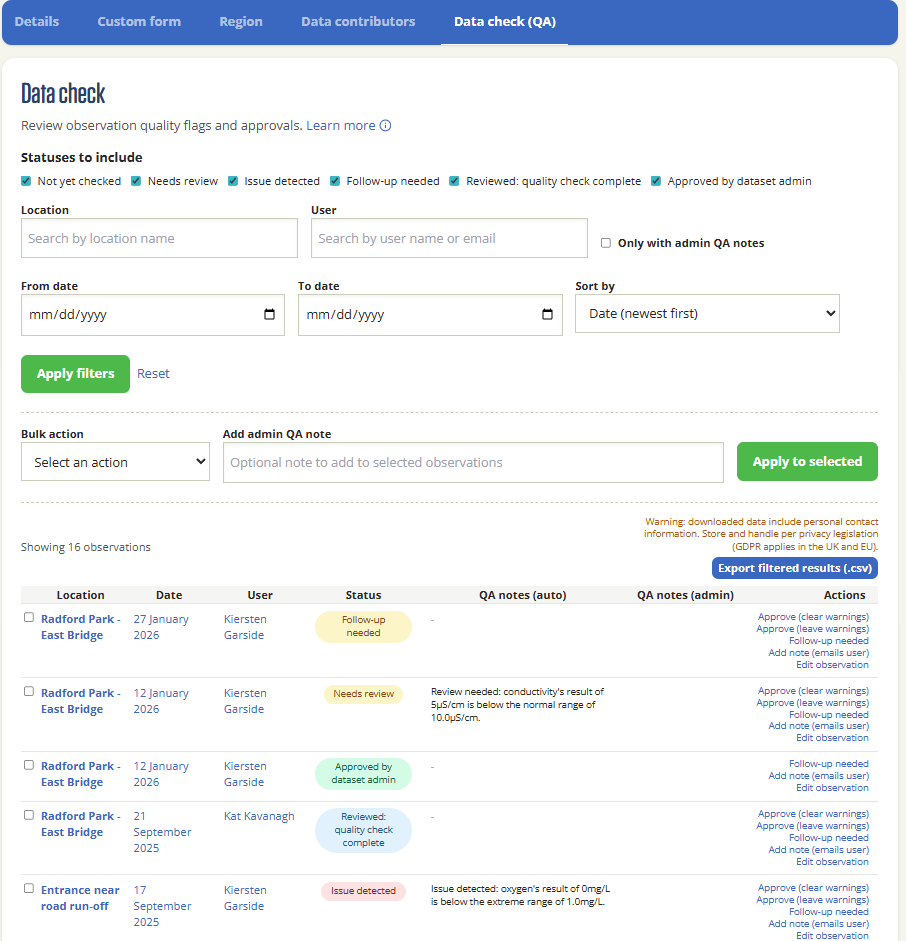
- Review flagged observations from your Data check dashboard.
- Approve, edit, or mark observations for follow-up.
- Use the dataset administrator QA notes to communicate with collectors about their observations. Notes are visible to everyone and will be emailed to the data collector.
- Set a regular schedule to review flagged observations. If your group follows our monthly testing protocol, we recommend reviewing at the start of each month after the testing weekend.